In her seminal 1991 monograph, Rights Talk, Harvard Law Professor Mary Ann Glendon confronted the impending crisis brought about by an increasing dependence on rights-based language in American political culture. "Our rights-laden political discourse does provide a solution of sorts to the communications problems that beset a heterogeneous nation whose citizens decreasingly share a common history, literature, religion or customs,” wrote Glendon, “But the ‘solution’ has become part of the problem." Glendon argued that the framing of political and cultural disputes through an oversimplified lens of individual rights distorted the rich traditions of ordered liberty on one hand, and civic responsibility on the other, which have characterized the American experiment.
Thirty-five years later, Glendon’s exploration of how rights-based appeals have impacted the integrity of the post-World War II human rights project are all the more prescient. Polarization has made finding common ground across political lines on contentious rights issues, from abortion to immigration, seem altogether impossible. The shared public square has been increasingly abandoned in favor of partisan bubbles, which allow the oversimplified political language described by Glendon to flourish. Simultaneously, political apathy threatens to erode essential American institutions.
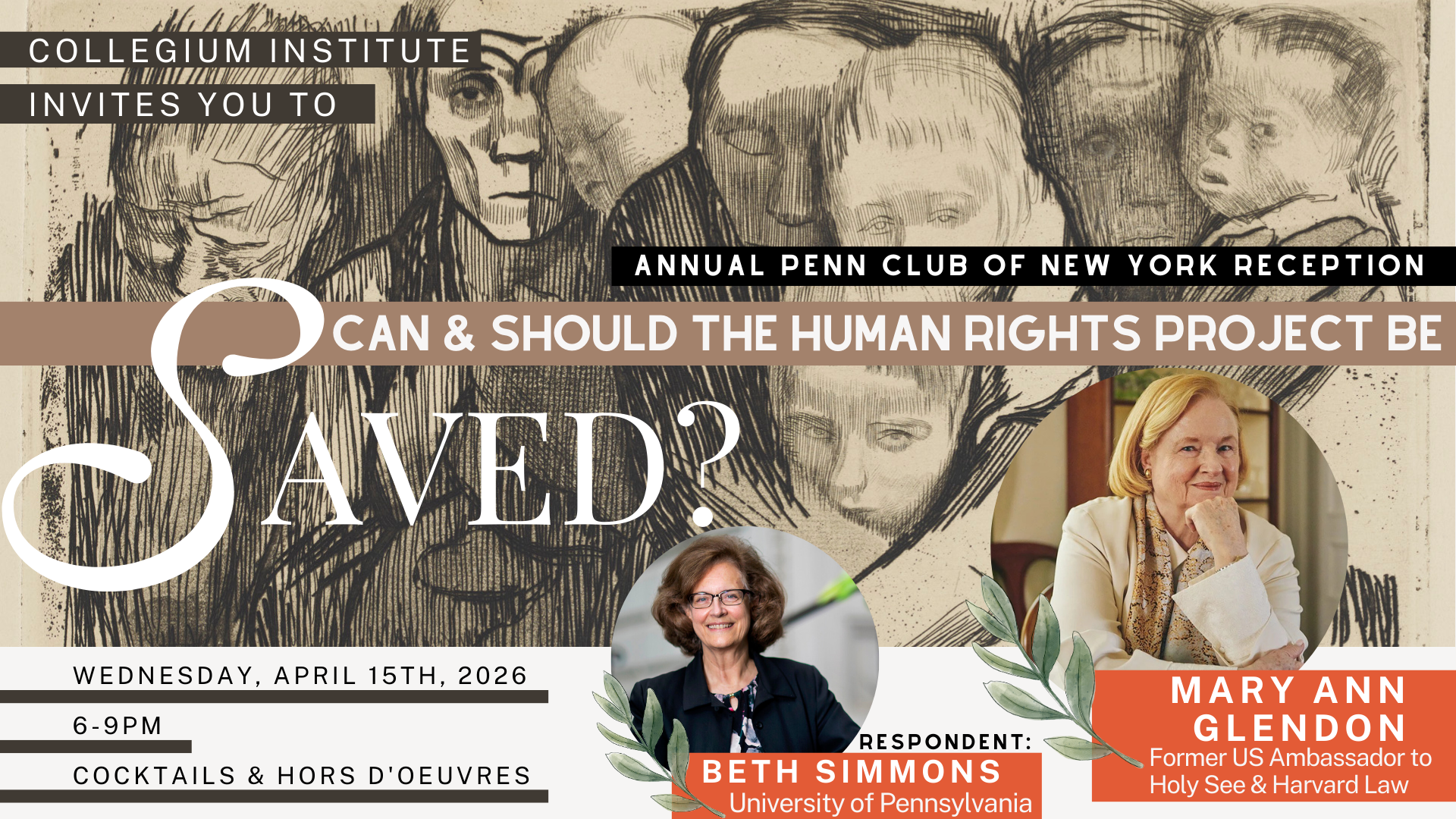
At Collegium Institute’s 2026 Annual Penn Club of New York Reception, “Can and Should the Human Rights Project be Saved?”, Prof. Glendon and Prof. Beth A. Simmons (University of Pennsylvania) will revisit the legacy of Rights Talk, and reconsider the future role of rights-based language—and the human rights project more broadly—in American politics, both foreign and domestic. Join us as we mark the 250th anniversary of the signing of the Declaration of Independence and consider what form the “inalienable rights” promised therein should take in the contemporary American landscape.
Our event opens with refreshments at 6:00 pm, followed by our formal program at 6:45 pm, then a reception from 8:15 pm until 9:00 pm. Early Bird tickets of $55 are available until Monday, March 16. Tickets are $75 thereafter. Student tickets are $25. Collegium Student Fellows are invited to contact Collegium Institute staff directly regarding admission to this event.
Date: Wednesday, April 15, 6:00 PM - 9:00 PM
Location: Penn Club of New York (30 W 44th St, New York, NY)
Order of Program
6:00 PM - Refreshments
6:45 PM - Featured Remarks
8:15 PM - Reception
9:00 PM - Conclusion
To register, please click the button below. Questions? Please contact Quinn Moore (qmoore@collegiuminstitute.org).
Mary Ann Glendon is the Learned Hand Professor of Law, emerita, at Harvard University, and a former U.S. Ambassador to the Holy See. Glendon chaired the U.S. State Department Commission on Unalienable Rights (2019-2020) and served as a member of the Commission on International Religious Freedom (2012-2016), and the U.S. President’s Council on Bioethics (2001-2004). She received the National Humanities Medal in 2006. Previously, she served as president of the Pontifical Academy of Social Sciences (2003-2013), member of the Board of Supervisors of the Institute of Religious Works (Vatican Bank) (2013-2018), and leader of the Vatican delegation to the 1995 U.N. Women’s conference in Beijing.
Beth A. Simmons is the Andrea Mitchell University Professor of Law, Political Science, and Business Ethics at the University of Pennsylvania. She researches and teaches international relations, international law and international political economy. Her books Who Adjusts? Domestic Sources of Foreign Economic Policy During the Interwar Years (2004) and Mobilizing for Human Rights: International Law in Domestic Politics (2009) won the American Political Science Association's Woodrow Wilson Award for the best book published in the United States on government, politics, or international affairs. Simmons previously served as director of Harvard’s Weatherhead Center for International Affairs and president of the International Studies Association.
We welcome First Things, Portsmouth Institute for Faith & Culture, America Media, the Thomas Merton Institute for Catholic Life at Columbia University, and the Harvard Catholic Forum as co-sponsors.