The Commodification of Community Service for College Applications
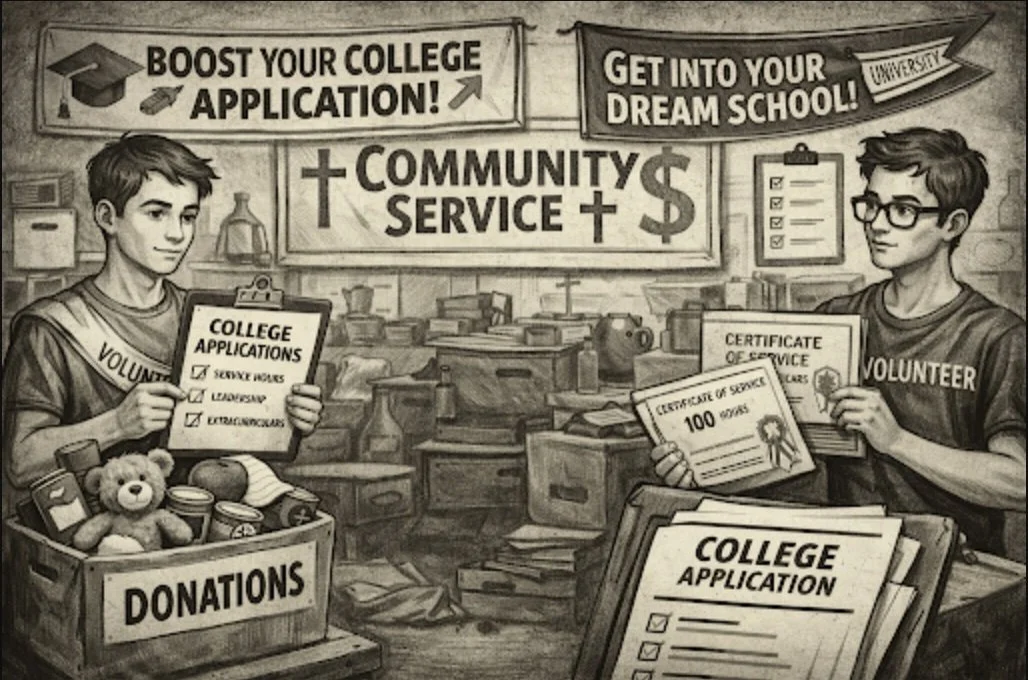
OpenAI, ChatGPT, “The Commodification of Community Service”
“Be careful not to practice your righteousness in front of others to be seen by them. If you do, you will have no reward from your Father in heaven.” (Matthew 6:1). A phrase so central to Catholic life that it is used as the primary Gospel reading for Ash Wednesday. It represents the idea that community service and volunteering should be authentic in the sense that it solely focuses on helping those in need. There should be no ulterior motives present, especially a motive to seek some form of public attention or validation. Yet despite this verse defining the Catholic doctrine of community service, I worry that too many Catholic youth are commodifying service to achieve another goal: admission into one of America’s elite universities.
While I am writing this blog more from personal experience than empirical fact, I do strongly believe (and worry) that this trend of commodifying service extends beyond my lived experience to most Catholic youth in the US. With elite universities serving as a gateway to high-paying, prestigious jobs, American society has placed a strong emphasis on getting into the top schools — to the point where students will do almost anything, including commodifying service, to gain admission.
For context, I saw this trend develop throughout my four years at Regis High School, a tuition-free, all-boys Jesuit high school in New York City with rigorous academics and a strong tradition of sending students to the top universities. Naturally, given its Jesuit identity, Regis always placed a strong emphasis on social justice and service — to the point where they made community service a requirement to graduate. It was best encompassed by our motto: “Men for Others.” This culture had an overwhelmingly positive effect on me. It encouraged me to work with a Catholic refugee school in Malaysia and recruit Regis students to serve as online teachers in English and Math. I wanted to help underserved communities access the education they deserve, and I wanted to challenge myself by tackling a global project instead of simply volunteering in my local area.
But it was in this position that I started noticing the commodification of service for college admissions. I had been leading the initiative throughout my junior and senior years of high school when suddenly, after I got accepted into Penn, underclassmen started asking me about potential leadership opportunities. Some of them hadn’t even been that consistent in teaching their weekly classes, so I naturally became suspicious.
As I approached graduation, I had to select a new leader for the initiative, as even though I am still actively involved as a leader and online teacher today, I needed a representative at my high school to communicate with all the Regis volunteers. Wary of what I had experienced a few months prior, I tried to pick someone who had been consistent in teaching classes and always volunteered to contribute to curriculum-building projects.
Yet, even after choosing someone I believed was most committed to the central mission, I could eventually tell he had underlying ulterior motives for the service work. By the time I started college, he started constantly pinging me about how to best frame his community service work in his college essays. And then, when he was accepted into a T-20 university, he quit and immediately pawned off his responsibilities to another Regis student, who similarly asked me how he could boost his college application with this service experience.
Now, I’m not against students using their experiences with social impact or justice in their college applications. After all, it is an activity you committed time towards, and not reporting it would not accurately capture your high school experience. I am the first to admit that I highlighted my work with the refugee school in my college application to Penn, and I don’t believe there is anything inherently wrong with that.
Instead my issue is with the underlying motive people have for pursuing service. Clearly the student leaders following me were much more interested in boosting their college applications instead of furthering social impact.
And this problem will only be made worse by the fact that this is a self-reinforcing, perpetual cycle. Since more and more students are applying to colleges with volunteering experience, admissions officers have started to expect that strong applicants have community service experience, with 58% of officers agreeing that community service has a positive impact on university admission (1). This has prompted admissions counseling organizations like Ivy Coach, Niche, and Academic Approach to publish blogs emphasizing the importance of community service in college admissions. This will push even more students to view and pursue the service work as a commodity, and the cycle will perpetuate.
But perhaps the existence of this inauthentic volunteerism, while highly problematic and unfortunate, still serves as a net positive. After all, it does at least incentivize more Catholic youth to participate in service work they otherwise would not have. It is similar to requiring community service hours: the goal is to incentivize students to serve in the first place, not necessarily to have them do so for the most moral or authentic reasons. Although the Book of Matthew outlines the moral, appropriate way to serve those in need, perhaps it’s permissible for some to seek ulterior motives if it means that overall more people will serve.
References:
Newton, Derek. “New Survey Shows Value of Community Service in College Admissions.” Forbes, April 5, 2018. https://www.forbes.com/sites/dereknewton/2018/04/05/new-survey-shows-value-of-community-service-in-college-admissions/#15ef61a43d3a.