Image sourced from the Conversation
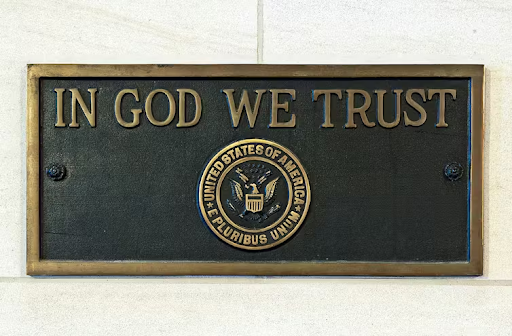
“In God We Trust.” A phrase so overtly theological that it seems more fitting on a church bulletin than on every American bill and coin. Yet it has become one of the most visible expressions of national identity in the United States.
The motto first appeared in 1864 on the two-cent coin after Protestant ministers pushed for its adoption to incorporate a reference to God in national symbolism. By 1955, Congress required the motto to appear on all currency, and a year later, President Eisenhower made it the official national motto, replacing “E Pluribus Unum.” Although the phrase does not specify a religion, its meaning is unmistakably religious, raising questions about whether it blurs the constitutional line separating church and state.
America has long prided itself on its separation of church and state. Ever since the inception of the Constitution, the Establishment Clause has ensured that there is no government sponsorship of any particular religion. However, this separation has faced serious pressure over the years. States have attempted to mandate the posting of the Ten Commandments in classrooms and to authorize publicly funded religious charter schools.
But the U.S. Supreme Court has consistently rejected such efforts. In Stone v. Graham, the Court struck down a Kentucky law requiring Ten Commandments posters in classrooms, even when privately funded. And in Oklahoma Statewide Charter School Board v. Drummond, it stated that a publicly funded Catholic charter school would violate the Establishment Clause by constituting state endorsement of religion.
Yet when challengers have targeted “In God We Trust,” the Court has repeatedly declined to intervene, often categorizing the phrase as mere “ceremonial deism,” a symbolic reference to religious heritage rather than a genuine governmental promotion of faith.
To analyze whether this motto violates the Establishment Clause, it is important to evaluate it under the Lemon Test, a three-pronged test that determines whether a particular action or law violates the Establishment Clause. Under the Lemon Test, a government action must have a secular purpose, neither advance nor inhibit religion, and avoid excessive entanglement with religion.
Our national motto fails the first two prongs. Its origin was explicitly religious; the ministers who advocated for it sought divine acknowledgment from the federal government. And the phrase advances religion by affirming belief in a monotheistic God – a view not shared by all citizens or faith traditions – effectively favoring monotheistic religions over non-monotheistic ones. Courts may call such language “ceremonial,” but ceremony does not erase the constitutional problem.
If the United States is committed to a genuine separation of church and state, it must ensure that its principles and values reflect that commitment. A motto, while tangibly insignificant, is the most obvious embodiment of such principles and values. So, the national motto should be restored to “E Pluribus Unum.” It would not only honor constitutional principles by not promoting religion, but it would also bolster national unity with a phrase steeped in tradition.
Bibliography:
Glass, Andrew. “‘In God We Trust’ to Appear on All U.S. Currency, July 11, 1955.” POLITICO, 2017. https://www.politico.com/story/2017/07/11/in-god-we-trust-to-appear-on-all-us-currency-july-11-1955-240337.
McMullen, Angela. “In God We Trust.” EBSCO, 2023. https://www.ebsco.com/research-starters/history/god-we-trust.
Pew Research Center. “The Lemon Test.” Pew Research Center’s Religion & Public Life Project, 2009. https://www.pewresearch.org/religion/2009/05/14/shifting-boundaries6/.
Totenberg, Nina. “Supreme Court Blocks Creation of Religious Charter School in Oklahoma.” NPR, 2025. https://www.npr.org/2025/05/22/nx-s1-5407475/supreme-court-religious-charter-school-oklahoma.