On Reading the Buddha’s Discourses and the Qur’an
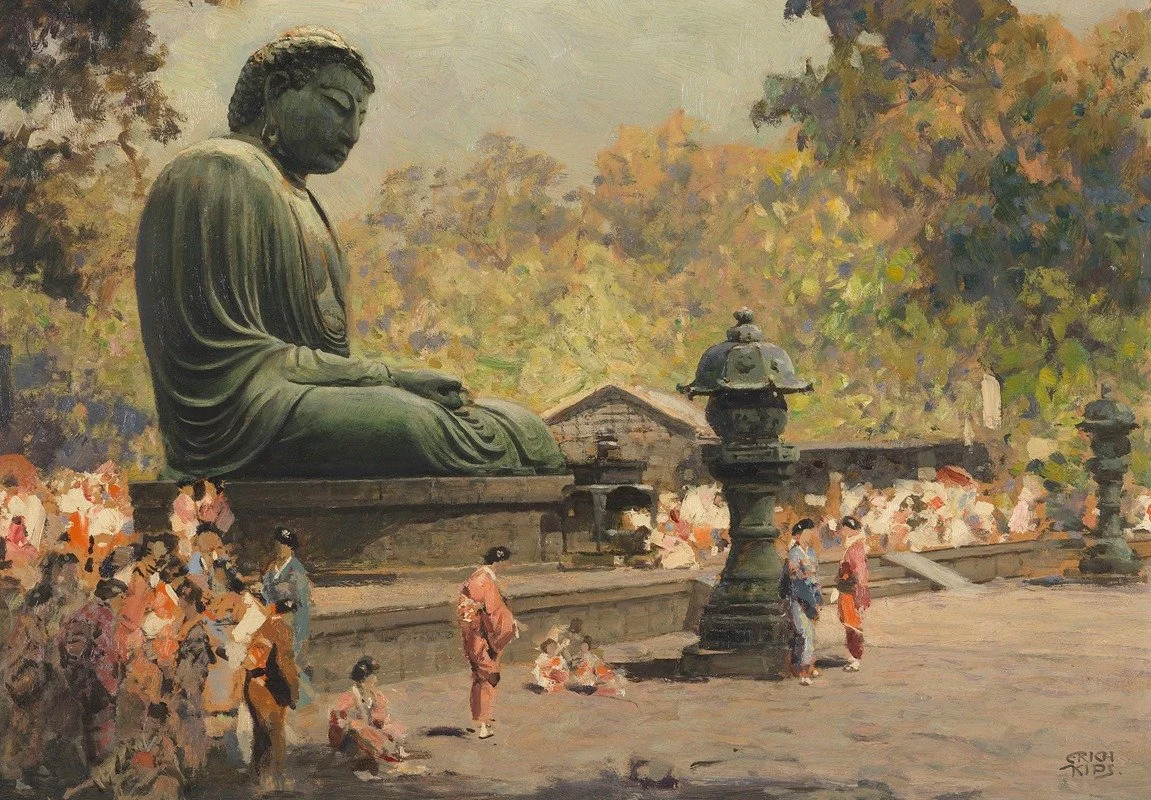
The Great Buddha (Daibutsu) in Kamakura, Japan (Ca. 1928), Erich Kips (German, 1869–1945)
Bhikkhu Bodhi speaks of two Buddhas in the earliest chapters of In the Buddha’s Words: a naturalistic, human teacher and his counterpart—a destined, divine saviour. I first encountered this naturalistic Tathāgata in Ven. Walpola Rahula’s What the Buddha Taught. It affirmed for me what I’d known in callower days: English could be rather beautiful.
Early on, in the first chapter, Rahula recounts the story of the Kālāmā Sutta. The Buddha arrives in a town called Kesapputa; its inhabitants are the Kālāmā. The Kālāmās come up to the Blessed One and relay their trouble: religious men come and go, preaching their doctrines, admonishing those of others. They don’t know which of these men to believe: all seem learned, all seem confident in what they say.
The Buddha’s advice is formidable to those who know it. He says: ‘Be not led by the authority of religious texts, nor by considering appearances, nor by the delight in speculative opinions, nor by seeming possibilities, nor by the idea: “this is our teacher”’ (Rahula 1974, 3). But when you know for yourself, having practised and experienced, that this or that is true and wholesome, follow it; otherwise discard it.
When reading the Qur’an, I considered such a delineation: parsing the Prophet as both divine emissary and human teacher. He delivers bountifully on his divine mandate. God is grand and magnanimous in the holy text: one loves him, fears him and feels his parental affection for us. The text admonishes and harps about the cataclysms awaiting the disbelievers. It emphasizes love and compassion for the poor, the needy, the orphaned.
Often, those to whom paradisiacal gardens, streams and companions will be gifted are said to be believers and helpers of the propertyless. The twain conditions appear so often that it is cemented that one must both believe in God and care for his creations. À la bell hooks, love—faith in God, here—is an action.
As a human teacher, the Seal of the Prophets errs like us and is admonished for it. One salient example is in Sura ‘Abasa, where God reproves the Prophet for ‘frown[ing] and turn[ing] away’ from a blind man (Qur’an 80.1-10).
The blind man approaches the Messenger of God seeking to learn from him, and in the Prophet’s drive to convert others—affluent disbelievers—to the faith, he neglects his duties and turns away. God criticizes him. It is a touching thing: a devoted man who lapses and is guided to the right path by a loving God.
One of the earliest religious lessons I remember being taught was that ‘Al-Qur’an’ meant ‘The Recitation’. How true that was! Repetition marks both the Buddha’s discourses and the Qur’an. Reading both coextensively, I was surprised by how the two texts rhymed: how, through iteration after iteration, the message is cemented; you become enmeshed. The immanence of God is instilled. Unsettling ideas like no-self—that there is no abiding element called the self, that your most intimate, essential sense of ‘I’ was an illusion—became atmospheric, became so potent, so palpable.
These texts are beautiful and eminently, delightfully weird. If anything intrigues you, why not practise dear Gotama’s advice? Read, experience, then judge as you will.
Bibliography
Abdel Haleem, M. A.S., trans. 2008. The Qur’an. Oxford: Oxford University Press.
Bodhi, ed. 2008. In the Buddha’s Words: An Anthology of Discourses from the Pali Canon. Teachings of the Buddha. Boston, Mass: Wisdom Publications.
Rahula, Walpola. 1974. What the Buddha Taught. New York: Grove Weidenfeld.