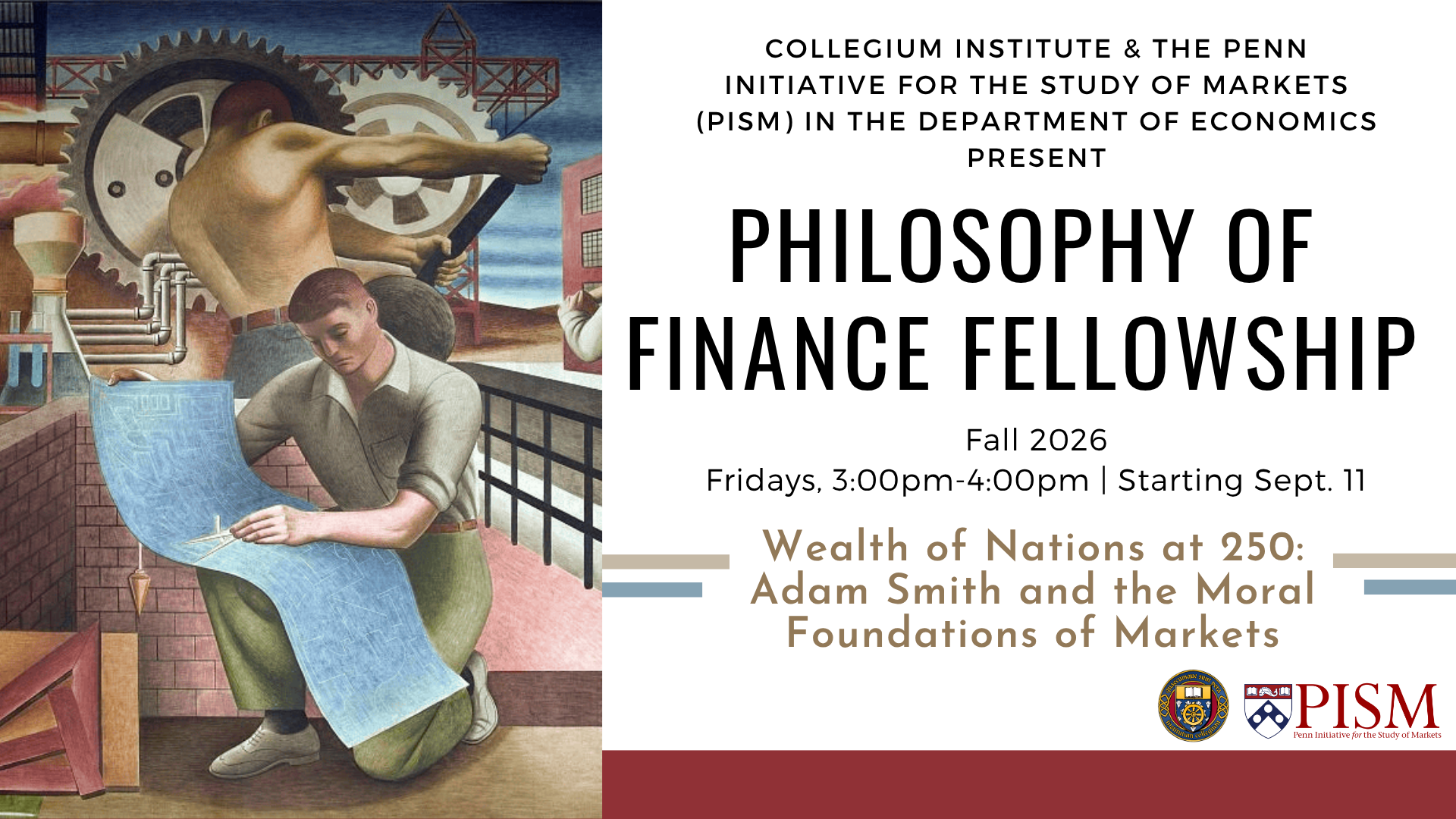
Collegium Institute invites you to apply to the Fall 2026 Philosophy of Finance fellowship “Wealth of Nations at 250: Adam Smith and the Moral Foundations of Markets.” This seminar marks the 250th anniversary of one of the most influential works in the social sciences: Adam Smith’s An Inquiry into the Nature and Causes of the Wealth of Nations (1776). It is, at its core, a celebration of Smith’s thought as a whole—not only the economics of Wealth of Nations, but the moral philosophy of The Theory of Moral Sentiments, which Smith himself considered the more important of his two books. More than two centuries after its publication, Wealth of Nations continues to shape how economists, philosophers, and practitioners of finance think about markets, exchange, and the state. Over time, however, “the Smith of economics” has often been read apart from “the Smith of moral philosophy”—a separation Smith himself would not have recognized, and one that has shaped, and at times distorted, how his arguments about markets are understood. This program is designed for a general, cross-disciplinary audience and assumes no prior background in economics: the emphasis throughout is on Smith’s ideas as moral and social philosophy, not on technical economic analysis.
We begin by examining this unity: how Smith’s account of sympathy in The Theory of Moral Sentiments underwrites the account of exchange that follows in Wealth of Nations. Participants will then turn to the text itself, encountering Smith’s account of the invisible hand, his treatment of the division of labor, and his critique of mercantilism, before returning at midterm to a question introduced in the first session: whether the self-interest of Wealth of Nations and the sympathy of The Theory of Moral Sentiments describe two different Smiths, or one—and where, in both books, Smith drew the line on self-interest himself. Along the way, one session takes up Smith’s writing on Britain’s American colonies—published, as it happens, the same year as the Declaration of Independence, whose own 250th anniversary this program is also glad to mark—though the seminar’s focus throughout remains Smith’s thought in its own right, not the American founding specifically.
The seminar concludes by engaging Smith’s contested legacy: how The Theory of Moral Sentiments went from being pronounced “dead” within a century of Smith’s death to a full scholarly revival two centuries later, and what that reception history suggests about how—and by whom—Smith’s ideas continue to be claimed today.
Our aim is not to adjudicate between Smith and his interpreters, but to understand both: what Smith was arguing in his own terms, how his ideas have been claimed and transformed, and what this ongoing conversation reveals about the philosophical foundations of markets and finance.
Dates: Fridays, 3:00-4:00pm
Sept. 11: The Unity of Smith's Thought with Dr. Fernando Arteaga
Sept. 18: The Invisible Hand(s): Market and Moral Sentiments with Dr. Fernando Arteaga
Sept. 25: Exchange, Self-Interest, and the Case Against Mercantalism with Dr. Fernando Arteaga
Oct. 9: The Limits of Self-Interest: TMS, WN, and the So-Called “Adam Smith Problem” with Dr. Patrick Fitzsimmons
Oct. 16: Smith and America: Colonies, Revolution, and Empire with Dr. Angel Alvarado
Oct. 23: Smith Today: Legacy, Appropriation, and Financialization with Dr. Fernando Arteaga
Location: Fox-Fels Hall 2nd Floor Conference Room (3814 Walnut St)
Application Deadline: Thursday, September 3, 2026.
Questions? Please contact Mary Lee (mlee@collegiuminstitute.org).
This fellowship was supported by a grant from the Lumen Christi Institute with funding from the John Templeton Foundation (Grant #63614).
Fellows