When the Stranger says: ʺWhat is the meaning of this city?
Do you huddle close together because you love each other?ʺ
What will you answer? ʺWe all dwell together
To make money from each otherʺ? or ʺThis is a communityʺ?
-T.S. Eliot, Choruses from “The Rock”
In a time of political polarization, deep disagreement on matters of life and death, and a seeming inability to find common ground, does it make sense to speak of the common good? What is the common good of the United States? Or to put the question in Augustinian terms, what are the common objects of our love as Americans? Have we kept our republic; has our union long endured only to fracture on the 250th anniversary of our founding? Can Catholic Social Teaching help shed light on these essential questions and bring us from the darkness of division into unity on earth and ultimately into the shining city of God in heaven?
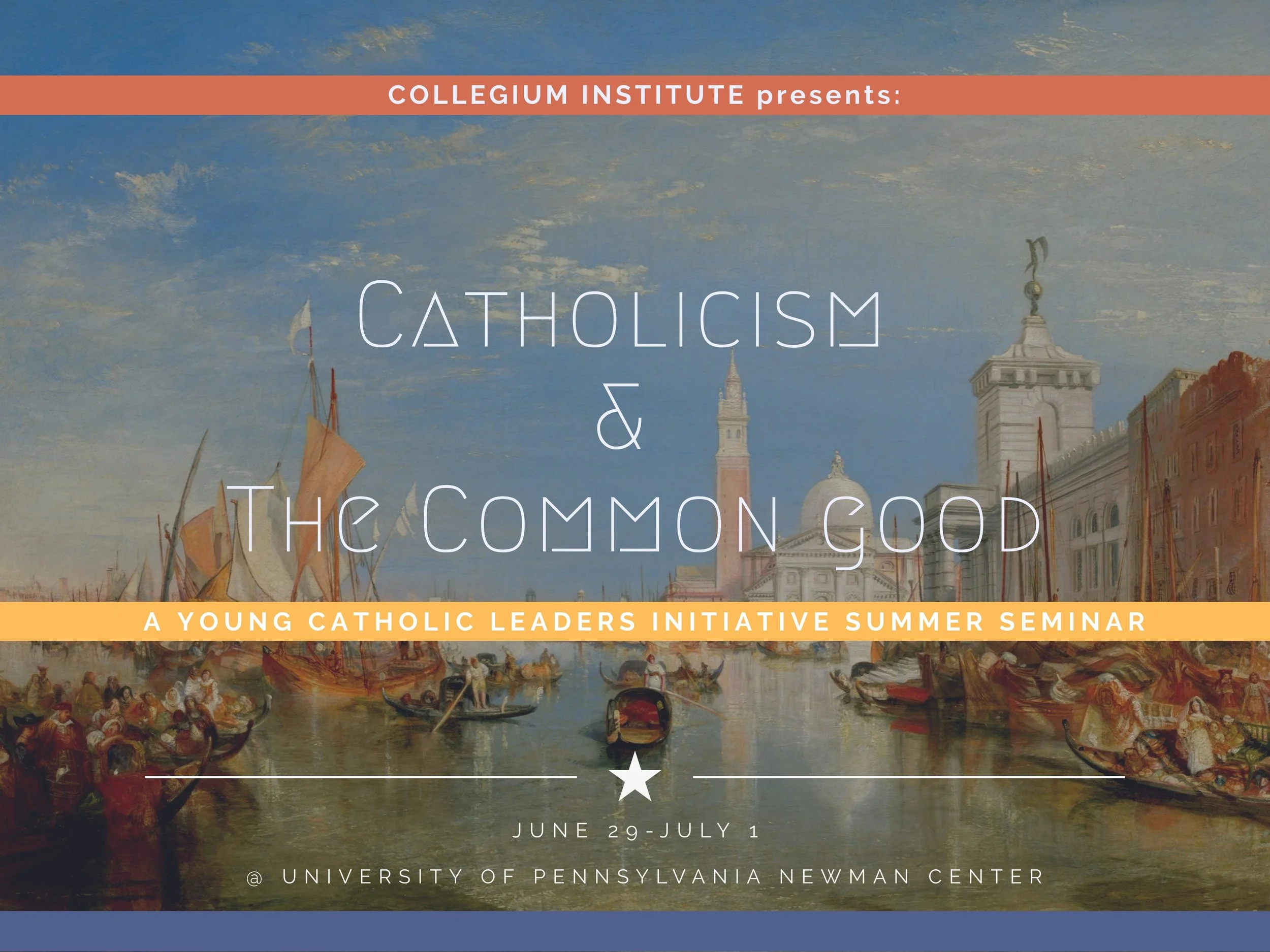
The 250th anniversary of the American founding is an ideal time, and Philadelphia an ideal setting to consider how Catholic Social Teaching applies to our specific circumstances. Over the course of three days, June 29-July 1 at the Penn Newman Center, Catholicism and the Common Good, the sixth annual summer seminar of the Collegium Institute’s Young Catholic Leaders Initiative for high school students, will reflect upon the three necessary societies stipulated by Catholic Social Teaching—the family, the polity, and the Church. Through a combination of seminars and scavenger hunts, pilgrimages and feasts, we will explore the principles undergirding Catholic thought on the common good by engaging with thinkers ranging from Augustine and Aquinas to Walt Whitman and Wojtyla, as well as seeking to apply those principles in our own lives as faithful family members, dutiful citizens, and aspiring leaders in the Church.
Priority Application Deadline: Friday, March 27th
Click the button below to apply.
Questions? Please contact Joe Perez-Benzo (jperezbenzo@collegiuminstitute.org).
This seminar was made possible by funding from the Connelly Foundation.