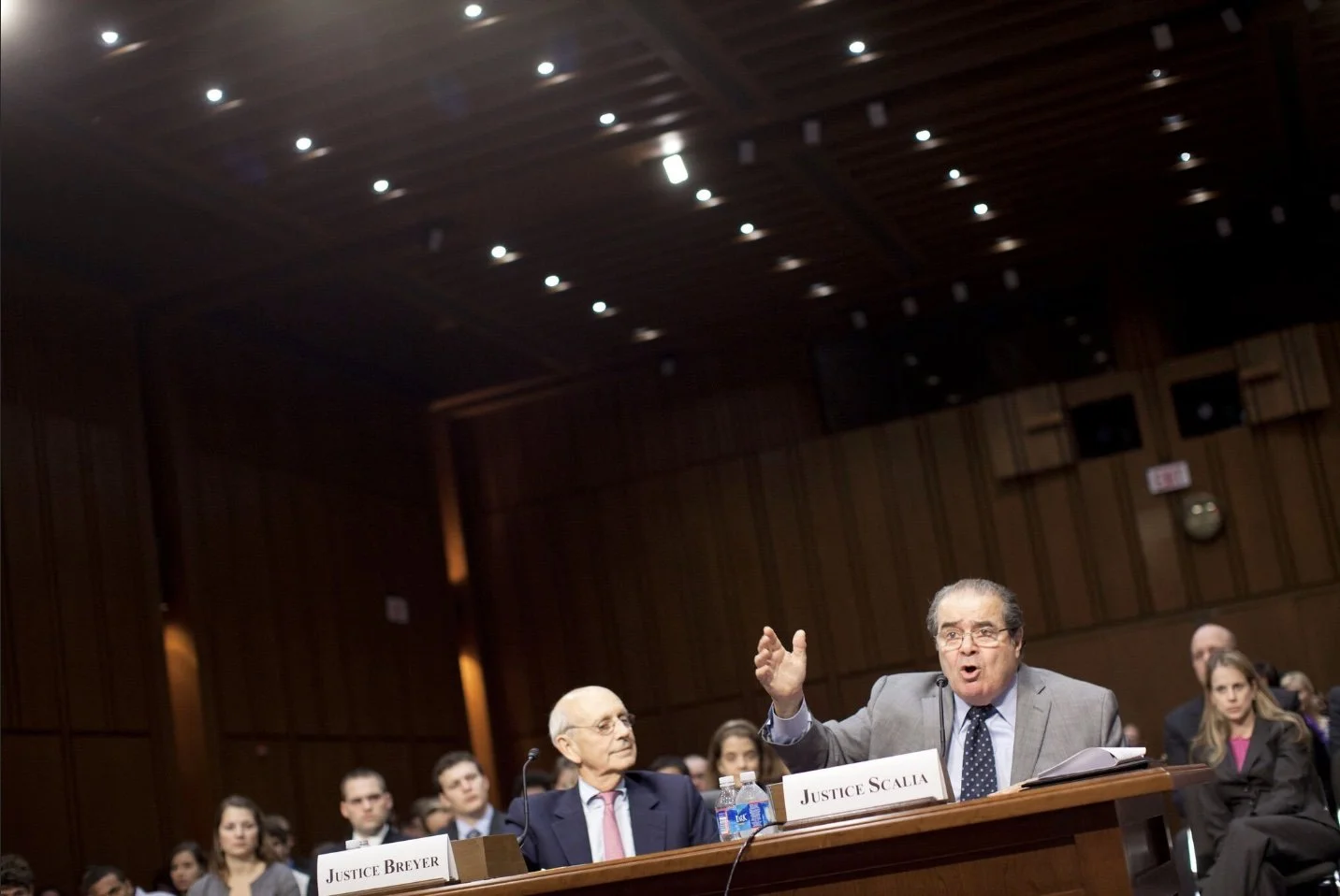
Justice Antonin Scalia testifying on Capitol Hill on October 5, 2011.
https://www.ajc.com/news/photos-justice-scalia-the-supreme-court/fQSy8kgl24MpHuisnvgyuO/
As I’m sure is an experience shared by many, a clip of Supreme Court Justice Antonin Scalia’s congressional testimony surfaced on my Instagram Reels when I was procrastinating doing my homework. Speaking before the Senate Judiciary Committee on October 5, 2011, the leading proponent of Originalism – the theory of applying the Constitution according to the meaning it had when it was adopted – sat before democratically-elected legislators and C-SPAN cameras, claiming that the “bill of rights of the former evil empire, the Union of Soviet Socialist Republics, was much better than ours” (1).
A devout Catholic, Scalia underscored that a regime that suppressed open expression and freedom of religion was not original in listing many rights, as many banana republics and authoritarian governments around the world claimed to protect foundational American freedoms. The USSR promised by law the “freedom of speech; freedom of the press; freedom of assembly, including the holding of mass meetings; [and] freedom of street processions and demonstrations,” which is more than is enumerated for American citizens by the U.S. Constitution (2).
This committee hearing was titled “Considering the Role of Judges Under the Constitution of the United States” (3). Scalia, a behemoth within the conservative legal movement and a staunch opponent of the shape shifting ‘Living Constitution,’ was not advocating for marxist principles or the seizing of the means of production. His point was that anyone or any state can compile a list of rights and enshrine them on a piece of paper, creating a “parchment guarantee” (1).
After all, written rights and protections are ignored and violated all the time by governments across the globe. For promised freedoms to materialize, there must be guardians and executors of the law. Justice Scalia claimed this was done by the divided power in the United States, and that having a real Constitution “means structure” (1). The existence of separation of power amongst three federal branches, bicameralism in the legislature, and, importantly, an independent court system, all form an ecosystem of accountability and enfranchisement, providing outlets for the violated to seek the reprieve of justice and rule of law.
A Founding Father and co-author of the Federalist Papers, James Madison acknowledges that “a mere demarcation on parchment” of each branch’s limits “is not a sufficient guard against those encroachments which lead to a tyrannical concentration of all the powers of government in the same hands” (4). The man who would later draft our Bill of Rights knew that words alone guard nothing. In Federalist No. 48, Madison is not warning against an evil monarch, but a legislative branch that can dress itself in the language of the people. This is why he explicitly calls for a “more adequate defence” for the “feeble” branches against the legislature, the elected despots (4).
The Union of Soviet Socialist Republics employed beautiful syntax, a literary tradition that produced the likes of Tolstoy and Dostoevsky, and etched it onto a paper constitution. Adopted on the eve of the Great Terror, when a campaign of political repression and mass executions were about to ensue, the “1936 Constitution” would prove feckless, with no one to enforce its “wonderful stuff” (8). Under Joseph Stalin’s iron fist, churches closed and clergymen were imprisoned. Further enumeration of privileges proved to be a waste of ink. So much for freedom of expression and religion. It becomes quite obvious that these “parchment guarantees” mean very little unless the eye beholding them commits to forming and upholding a system that understands the vulnerabilities of the rights of those who consent to be governed. Pope John Paul II, who lived under communism in Poland, observed how politics can become a “secular religion,” one where “people think they possess the secret of a perfect social organization which makes evil impossible, [and] they also think that they can use any means, including violence and deceit, in order to bring that organization into being” (5). Here, the utopian promise and the terror were the same project, two sides of one effort to promote a communist system.
Structure beats promises; after all, man’s rejection of the Lord, the peccatum originale, left each individual with a wounded human condition and a deprivation of original holiness and justice. Without any system to reinforce order, man is bound to falter and violate the rights of a neighbor. Madison knew this, professing in Federalist No. 51 that “If men were angels, no government would be necessary” (6). Even some of our more religiously creative and deist forefathers at the Constitutional Convention operated with this understanding. It then comes as no surprise that a devout Catholic and legalist like Scalia, someone who could seek inspiration from both Scripture and U.S. law, dedicated his life to a countermajoritarian institution, one that explicitly protects the minority, the abused, and the victims of injustice.
In light of man’s misguidedness, the Lord has given us ten wonderful commandments and a divinely inspired Scripture to assist in governing our lives. However, this is not all to say that frameworks and those who oversee them are the only things that can point to justice and virtue. Jeremiah 31:33 elucidates the fact that law is written on our hearts, not just tablets(7). Political structure, while a necessary guardrail in a fallen world, restrains vice but cannot supply us virtue. Being created in His image, we are capable of choosing justice from injustice, virtue from sin. The most timeless, powerful, and flourishing laws will be in correspondence with this truth.
And while structure may be necessary, it is not sufficient. Our dear Constitution, growing from ten points to twenty-seven, is a lonely piece of paper in museums or pdf on government websites without a citizenry that also wants justice. Even with attentive and active voters, injustice can perpetuate for decades and even centuries. Democracy does not inherently mean just consistent progress and protection of minority parties. The University of Pennsylvania’s motto goes, “Laws without morals are useless” (8). Inaction on legal statues is not only the threat to personal liberties, but also the unjust execution and enforcement of words on paper. Even when every procedure is followed, there can be various diverging interpretations of the same statute. Perceptions of immorality in law can feel disheartening, with some channeling this sentiment into claims of illegitimacy of the judicial system.
Scalia and his fellow justices knew this intimately. With increasingly harsh rhetoric pointed towards the judiciary coming from all sides, the institutions established to be a citizen’s safe haven were being twisted into partisan talking points, supposedly acting as threats to the democracy they were formed to protect. The answer to a disappointing SCOTUS decision is not to subvert the court and centuries of legal tradition, it is to hash it out in the legislature, amend the constitution, and engage with others in the public square. Every American has to make a choice whether to compel leaders to uphold promises made in parchment, whether to engage with the expansive view of our checks and balances, or to engage in a myopic view of alarmism and bias espoused on an ads-revenue outlet.
Anyways, the supreme court publishes its cases online and SCOTUSblog has free commentary on landmark cases. Have fun during these upcoming midterms, America. May we embrace our beautiful legal tradition, celebrate the separation of powers, and remember the political developments and sacrifices that got us this far. Happy 250 to the United States and happy 239 to the US Constitution.
References
Scalia's Testimony Transcript
1936 Constitution of the USSR Excerpt
Full Committee Hearing
Federalist No. 48
Centesimus Annus 25
Federalist No. 51
Jeremiah 31:33
Penn Motto