Imago Dei in the Declaration of Independence
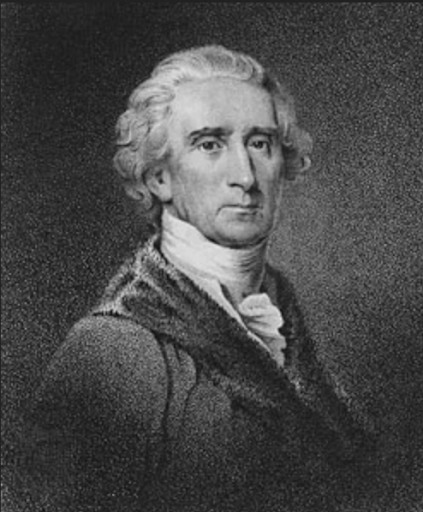
Maryland State and US Senator Charles Carroll, the only Catholic signer of the Declaration of Independence. shttps://www.britannica.com/biography/Charles-Carroll#/media/1/97080/16430
As the 250th July 4th anniversary approaches, I find myself reading more about Jefferson and the ideas that inspired him in writing the Declaration of Independence. Historians of Jefferson remarked on how his thoughts weren't always radically original. In a private letter, Adams caustically remarked, "there is not an original idea in it, but what had been hackney'd in Congress for two years before”(1). Jefferson seemed to agree with this sentiment, writing "I did not consider it as any part of my charge to invent new ideas altogether”(2), for the Declaration "was intended to be an expression of the American mind"(3). Adams wrote to lessen Jefferson's achievement, and Jefferson wrote to explain the purpose of the Declaration. However, they were both saying the same thing: the Declaration of Independence was meant to express how the colonists and delegates felt. It was putting into writing the democratic feelings of the people, and their yearning for their God-given rights. Jefferson's goal was to express the "American mind," a mind that felt abused by George III's denial of their democratic privileges, and one that felt abused through the unjust use of soldiers in the streets.
People familiar with the founders may know that many of them were deists, believing that God didn't directly intervene in the world; he was a great architect that set things in motion, but beyond that, wasn't present in daily life. Jefferson, as a deist, was likely more inspired by Locke's Second Treatise on Government than he was by passages from Genesis, making him less religious than many of his countrymen. The colonists were inspired by the Enlightenment, which helped them understand democratic principles. While teachings on human dignity can come from an understanding of the Church, American rights were heavily inspired by political action and the Enlightenment's ideas. However, despite Jefferson's deist beliefs and the separation between political and religious thought, Christian ideas about dignity and equality of humanity still came to the Declaration of Independence as Jefferson strove to represent the American mind.
To expand on what those Christian ideas are, I looked at the Catholic idea of human dignity. This idea originates from Genesis: "And God said, Let us make man in our image, after our likeness [...] So God created man in his own image"(4). As we are made in God's image, there is something special about each and every human, regardless of whether or not they are an Englishman or an American colonist. Regardless of whether they are strong or weak. Regardless of any factor that is used to divide people; we are still all created in the image of God. And in this sense, we are equal.
In the writings from the Second Vatican Council, the Church explained its teaching on human dignity by writing, "Since something of the glory of God shines on the face of every person, the dignity of every person before God is the basis of the dignity of man before other men"(5). In other words, we all have dignity from being made in the image of God, which splendidly shines on us. This dignity should be upheld in how humankind interacts with itself. A large scale of this interpersonal interaction is politics. This quote from Vatican II shows why the Catholic social teaching of the human dignity of each person connects to the idea of inalienable human rights. Treating each other with dignity includes respecting each other's fundamental rights. Jefferson and many Americans considered these rights to be those of "life, liberty, and the pursuit of happiness." These rights are "endowed by their Creator"(6). In other words, because we are made in the image of God, Imago Dei in Latin, we have dignity. This dignity is honored when our rights are upheld. Since the Creator has given us this dignity, and therefore our God-given rights, mankind must uphold these rights.
Before I wrap up, I'll note that most of the 56 signers of the Declaration of Independence were Protestants, representing the Protestant bent of the 13 colonies. There was one Catholic signer, though: Charles Carroll of Carrollton. Catholics, unfortunately, often faced discrimination at this time. In fact, Catholics were barred from public office in Massachusetts and New York(7). However, despite this, Carroll was a patriotic American who risked his life by signing the Declaration of Independence. He also outlived every other signer of the Declaration, dying in 1832 as America and the ideals of the Declaration continued to thrive in our country.
On this July 4th, I will be thinking about how my faith informs my understanding of the immortal words of the Declaration. My faith helps me understand the essential dignity in all of us. It gives me the conviction to strive for democratic ideals. The thoughts of Jefferson and the Enlightenment philosophers help me understand the fundamental rights that arise from that fundamental dignity. I want these ideals to guide how I treat others and how I act as a democratic citizen. I’ll make sure that I personally treat others with respect, and that my government upholds our rights, striving for liberty and equality.
References:
Letter from John Adams to Timothy Pickering
Letter from Thomas Jefferson to James Madison
Letter from Thomas Jefferson to Richard Henry Lee
Genesis 1:26, 27 KJV. KJV being the version most American colonists would’ve read.
Second Vatican Ecumenical Council, Pastoral Constitution Gaudium et Spes, 29: AAS 58
The Declaration of Independence
America’s True History of Religious Tolerance, Smithsonian Magazine