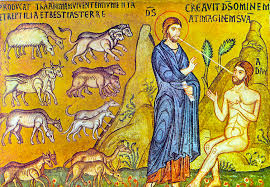
“Humanity As the Likeness of God,” https://www.thefaithlog.com/2019/10/humanity-in-likeness-of-god.html
College is a pivotal time in which people try to discover themselves and their purpose in life. It can’t help but seem that many who have this desire feel a sense of restlessness and lack of direction, yet beneath this they lack something essential: their roots. It is easy to take for granted how unique humanity is compared to all creation, fall prey to a sense of idleness taken by comfort, and return to a more animalistic nature. Especially with the explosion of artificial intelligence, many choose to surrender their intellectual brilliance for human passivity to avoid laborious rigor. It is therefore essential to know and return to our roots, the source by which we operate, and to find the end in which we are made for. Then and only then will man’s sense of idleness and identity be fulfilled, and his human nature regained.
The first base at which man must stop and ponder is that they are made in the image and likeness of God. This is the characteristic that separates us from the beasts and all of creation, as we are able to know and to love. In fact, the Catechism of the Catholic Church speaks of this in paragraph 356:
“Of all visible creatures only man is ‘able to know and love his creator’. He is ‘the only creature on earth that God has willed for its own sake’, and he alone is called to share, by knowledge and love, in God's own life. It was for this end that he was created, and this is the fundamental reason for his dignity” (CCC 356) (1).
Notice here the allusion to a cycle where there’s a fundamental start, and ultimate finish. The origin of man’s dignity, the very thing that gives him his worth, is from God and for God. Speaking on this source, St. Thomas Aquinas discusses what it means to be made in the image and likeness of God, and specifies the uniqueness of intellect:
“Augustine says (Gen ad lit. vi, 12): Man’s excellence consists in the fact that God made him to His own image by giving him an intellectual soul, which raises him above the beasts of the field. Therefore, things without intellect are not made to God’s image.” (ST I, 93, a2) (2).
The attributes of the intellectual soul which are being referenced here are what Aristotle describes as rationality: the ability to reason, plan, and guide actions. Rationality is the principal root that must be discovered, in that we have the capacity to truly understand things, rather than follow an instinct or recognize patterns, and contemplate the truth. Christ says that the truth will set you free; therefore, our understanding of the truth and contemplation of it is what allows us to be truly free. This does not mean that merely knowing a plethora of facts frees us, but rather knowing truth itself, or Christ Himself, as He says, “I am the way, the truth, and the life” (3). We are made to know God, to understand him, and to ultimately possess him.
The second action the Catechism describes as uniquely man’s is the ability to love his creator. To understand this, the definition of love must first be looked at. The Catechism describes it as such:
"To love is to will the good of another." All other affections have their source in this first movement of the human heart toward the good. Only the good can be loved. Passions "are evil if love is evil and good if it is good." (1)
There are three principles within this definition that must be looked at. The first is to will, which in this case, causes some sort of action to take place. Next is the good, which is not merely a kind of arbitrary feeling, but rather the true good that the person needs, the Summum Bonum. Finally, there is another, which indicates love involves another person; a lover and a beloved. With these three principles established, one may wonder how this is unique to humanity. After all, animals can love their offspring in similar ways humans do. Well, it was stated previously how humans can grasp the good and understand it in ways animals can’t. With that being said, humans can truly come to understand what is good for another and will it for them. Humans are able to love another for their own sake and not just from a mere instinctual calling. When we look through the lens of love at the creator, we are able to love Him for Him, not just what he provides us.
Essentially, humans are called to know and to love their creator as it is what gives us our purpose in life. Being made in the image and likeness of God separates us from the beasts, enabling us uniquely human characteristics that should not be diminished for passivity. In any endeavor one takes, when they know they come from God and are made for God, a spark is rekindled and a newfound hope for truly living arises. In a society that seems to lack purpose and identity, it is crucial to understand where we came from and what we are made for. We are made for greatness; we are made to know and to love our creator; we are made for God.
References: